Home › Applications › Terminals and passenger hubs
Passenger Transfer Solutions for Terminals and Passenger Areas
Movement inside a terminal, links between terminals and car-park shuttles are separate needs. We assess projects that call for specialist expertise together with their scope and the suitability of the vehicle.
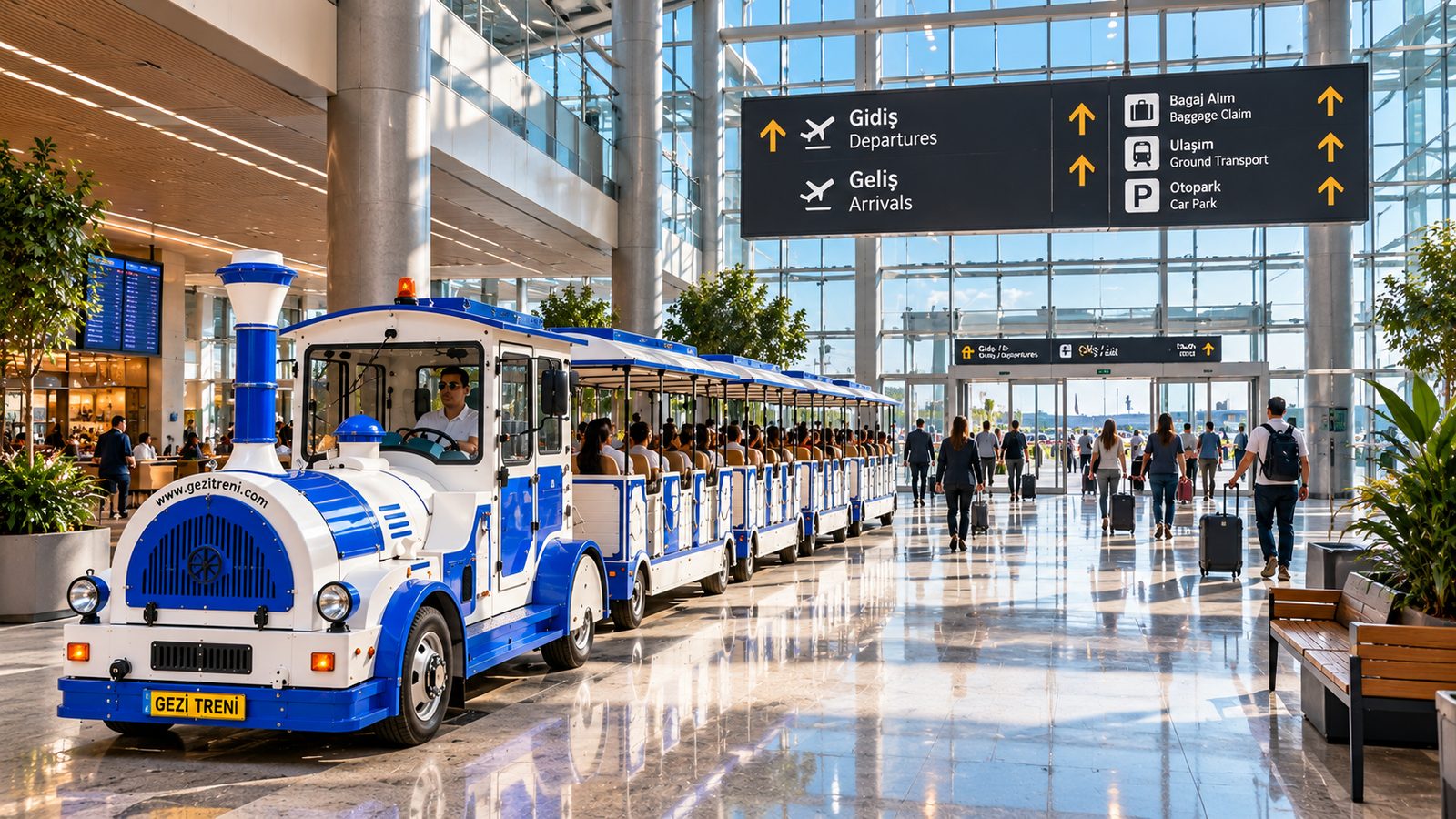
Movement inside terminals
Use can be considered for passenger transfer from the check-in area to the gates or from passport control to the gates. Corridor width, turns, pedestrian density, ground surface and the airport operator’s conditions are decisive; for indoor use, vehicle suitability and operator approval are assessed together.
Multi-car, bi-directional passenger tram
There is also a high-capacity passenger tram made up of several cars. With a driver’s compartment at both ends, it can be driven in two directions without turning, which suits areas where manoeuvring is limited and turning is not possible. Two cars of 24 passengers each carry 48 passengers; capacity can be increased. A twin-motor, four-car configuration can carry up to 200 passengers, seated and standing. It is very efficient on long routes. It can also be considered for airports; suitability and the operator’s approval are assessed separately in such areas.
Links between terminals and to car parks
The nature of the route, the number of passengers and amount of luggage, the timetable and the operating hours are the basis. A traffic-free site road and a public road are not treated within the same scope.
Apron and port transfers
With the airport’s approval and a suitability assessment, use can be considered for passenger transfer between the aircraft and the terminal building on the apron. This operation requires separate expertise. Passenger and luggage transfer at cruise and ferry areas is also examined separately; no commitment is given before technical suitability and operator acceptance are confirmed.
Which areas is it suitable for?
Open areas are considered, such as terminal forecourts, passenger waiting and car-park areas, closed facility roads and links between terminals and parking areas. Areas around bus terminals, railway stations and ports are also assessed separately.
Passengers and luggage
Passenger numbers, amount of luggage, the need for easy boarding and alighting, and use by elderly and disabled passengers are planned together according to the project. Separate luggage space options can be discussed.
Security zones and operator approval
In airports, ports and similar security-restricted areas each project is assessed separately. No commitment is given before the operator’s approval and the relevant permits are obtained.
Model and power choice
Mini is considered for compact areas, Midi for medium-sized ones and Maxi for heavy passenger volumes and long lines; Mini carries up to 64, Midi up to 112 and Maxi up to 128 passengers. The electric option stands out for quiet, exhaust-free operation around terminals.
Multilingual commentary
For passengers from different countries, the GPS-triggered multilingual commentary option can give stop and direction information in their own language. This option is assessed within the project scope.
Advertising and revenue opportunities
The tourist train’s large outer surfaces and its above-floor billboard areas can be used for advertising and announcements. Screens can also be fitted inside the wagons for visual advertising and announcements; this option is assessed within the project scope. Ticket revenue can be earned, and because local businesses can advertise, it also supports the local economy. Advertising is planned according to local regulations and permits.
What do we need for a quotation?
The site plan or approximate line length, the number of stops, passengers and luggage to carry at peak hours, operating hours, ground and gradient, your preferred engine type, where it can be charged and the operator’s conditions. With this information the assessment is made much faster.
Frequently asked questions
What is the difference between a terminal vehicle and a tourist train?
Vehicles for use inside a terminal must be compact and suitable for indoor use; an outdoor tourist train is not automatically recommended for the same purpose.
Why is an apron transfer assessed separately?
The operation, the operator’s acceptance and the vehicle requirements call for a separate suitability study.
Is it suitable for terminal forecourts and car-park loops?
Use in open areas and on closed facility roads is considered. Route, passenger density and operating hours are assessed together.
Is it suitable for passengers with luggage?
The model and wagon layout are planned according to passenger and luggage volumes; separate luggage space options are discussed at the project stage.